Author: Claire

  • Read it!: Big Magic

    I’m trying to get my writing mojo back, and a part of that process for me involves getting caught up on my reading. Simultaneously, I figure it can’t hurt to share what I pick up along the way.

    Last winter I bought a ton of books, but didn’t have time to read them. Fortunately, in 2019, the tables turned.

    Every now and then, I’m going to share with you my insights into the good, bad, and the ugly side of my reading material. And so, whether you’ve read it or not… This time around I’m covering Elizabeth Gilbert’s last book.

    I know I’m late to get on the Elizabeth Gilbert love train. Last year my therapist loaned me her copy of Eat, Pray, Love. (I haven’t finished it, but I need to return it.) Prior to that, though, I first laid my eyes on Elizabeth via one of her TED Talks.

    I thought she had a refreshing take on life and creativity, and when Big Magic was released, the hype was hard to ignore. The subtitle alone was enough to grab my attention: Big Magic – Creative Living Beyond Fear.

    Ohhhhhhh boy, I thought. I NEED this book. Although I think of myself as a creative person, I’ve let fear and procrastination keep me from creating anything substantial for years. (When I think of all the time since I first graduated that I could have spent writing a book, it’s a damn shame.)

    As I approached Big Magic I was curious about Elizabeth’s approach. Within the first few pages, I found it incredibly easy to root for her premise. Regardless of your area of creative interest–whether you’re pursuing the arts, or your drug of choice involves math or science, when you create–when you MAKE something–you are taking a risk and daring to demonstrate your willingness to approach The Unknown. Putting yourself out there is scary. To dare to extend yourself is a powerful thing.

    Ultimately, Big Magic is a prolonged pep-talk. Divided into SIX sections, and at 272 pages, the book’s length combined with its tone made it a quick, comfortable read. Throughout her book’s pages, Elizabeth encourages readers to boldly greet their creativity, embrace, and enjoy it.

    She also includes a few curious concepts. For instance, consider The Shit Sandwich. Whether you’re pursuing your dream full-time or dealing with a day job, in the segment entitled, “Persistence”, Elizabeth asks the ultimate question: “What are you passionate enough about that you can endure the most disagreeable aspects of the work?”

    When I first read those words, I smiled both inside and out. I could truly relate. As my last full-time position came to a close, I found myself questioning everything. Among other things, I actually remember thinking to myself, “None of this is worth it.”

    As the book went on, I found myself supporting just about everything Elizabeth has to say. But there was one exception: In the segment entitled “PERMISSION”, I found her usesing some that really bothered me. Actually, it was beyond bothersome: I found it offensive.

    When it comes to making things, Elizabeth says, “…in the end, it really doesn’t matter that much. Because in the end, it’s just creativity.” I was on high alert after reading that. And that statement wasn’t the only anti-creativity bomb that she dropped.

    Now, to a certain degree, I get it. There are times when people can take their creativity too seriously. As a result of their delusions, creatives can become overly stressed. And a part of me realizes that Elizabeth was probably trying to get certain folks not to worry too much and just enjoy the creative process. That said, regarding making music, Elizabeth wrote that, “Music is nothing more than decoration for the imagination. That’s all it is.”

    And when I read those words, I nearly threw her book away.

    Not only have there have been studies, but there are books that exist about the power of music and the effect that it can have on human beings. Regardless of which resources you choose, the authors’ statements are backed by science.

    Plus there’s the fact that I’ve always taken music personally.

    As a child, my mother sang in church. I remember very little about going to rehearsals with her. But one thing I could never forget is that I used to cry when she sang.

    Music moved me that deeply.

    That level of emotion stirred in my spirit again recently when I was watching a pianist on Instagram–of all places–playing Mozart. (Shoutout to Chloe Flower, Cardi B’s pianist.)

    I’ll spare you from more ranting, but in a nutshell, when people say that art doesn’t matter, it makes my blood boil. And even when I’m not that angry, it makes me struggle to take them seriously.

    Fortunately, after her comments on how unimportant art is, Elizabeth returned to her regular self. She discussed a few other relevant points, including the horrible myth that people buy into which states that artists can only create in the face of personal tragedy.

    In general I felt comforted by Elizabeth’s words. These days, in spite of opportunities to shine brighter, creatives can be plagued with the temptation to doubt their own authenticity. Yet among other things, she reminds us, “…you are already creatively legitimate, by virtue of your existence among us.”

    Overall, Big Magic offers readers lot of common-sense advice in a refreshing package. I enjoyed how Elizabeth framed various aspects of creativity. For instance, at one point she discussed the idea that one’s craft has to be formally studied in order to succeed professionally.

    If you’re a writer, you know the drill. Supposedly, in order to be a writer, you need an MFA, or you MUST go to journalism school. Yet in reality, nothing could be further from the truth.

    Would I read Big Magic again? If I have time to, maybe.

    Would I recommend this book?
    Eh…As I said before, It’s a quick, comfortable read. I like Elizabeth Gilbert. She’s seems like the type of person I’d go to lunch with. I like what she has to say about art and inspiration. Big Magic is light, warm, and mentally provocative.

    Yet again, I can’t forget about the passages in “Permission” where she said art was useless. That section threw me off so much that I actually caught myself wondering about the kind of debates Elizabeth might have had with her editor.

    Eventually, Ms. Gilbert encouraged her readers to “relax”. That’s very well and good, but I feel like she could have made her point without using statements that seemed to be so needlessly opposed to the book’s main objective. There are ways to tell people that they shouldn’t take themselves too seriously that don’t involve insulting their calling.

  • Flashback Friday: HERstory in video

    I’d heard there were videos that captured the HERstory in Black experience, but I’d completely forgotten. Then one day, I caught a clip on on How She Hustles’ Instagram account. Jully Black led the ladies as they sang “This Little Light of Mine”.

    I can feel the sisterhood in every frame of this video. Be sure to check out How She Hustles’ YouTube channel for more content.


  • A taste of HERstory: Reflections on an unforgettable evening

    In December, all I knew of HERstory in Black is that it was an idea. Emily Mills, CEO of How She Hustles had decided to step out on faith and share her vision: she wanted to create a digital photo series featuring 150 Canadian Black Women.

    Along the way, Emily asked the women of How She Hustles for help. I wasn’t sure of how I could be of service, but I knew one thing: I could write. Currently I live outside of the GTA, and my mobility is somewhat limited. But that little voice inside told me to volunteer anyways. Surely I could do something in spite of my location.

    A couple of weeks ago, Emily got in touch with me. Oh, how her project had grown. HERstory in Black now had a home in the form of a microsite on CBC Toronto’s web page. There would be an event in its honour on the 27th of February. Thanks to this new development, she didn’t need me to write about the women included in HERstory. But would I be able to showcase the photographers who made the magic happen?

    I nearly fell over.

    The Saturday after Emily and I chatted, I spent the afternoon with my girlfriends, Krista and Celeste. I told them all about HERstory in Black, including its celebration.

    “You have to go!” Celeste and Krista insisted.

    I looked at them as though they were made of cheese. I was already stunned by the thought of writing something about such an important project. I couldn’t imagine showing up at an event in its honour.

    In the days after I published my post, Ms. Mills and I messaged each other. She asked if I was sure I couldn’t make it out to the CBC for HERstory in Black. Again, I was taken aback. My brain had been in such a blur since writing about Leilah Dhoré and Ebti Nabag, the idea of actually appearing on Monday seemed like too much of a good thing. Plus, there were logistics. Currently I need a car of my own and a new job. I’m used to not making it out to see people.

    How would I get there? The next thing I knew, I was thinking of my friend Celeste. Since I didn’t have wheels, she’d offered to take me. I wondered if she could she be my plus one. Apparently God had the same idea because she won tickets to attend.

    She was able to bless her friend Janice with her extra ticket. We got together and along with Marla Brown (one of HERstory’s 150 women) we hit the road.

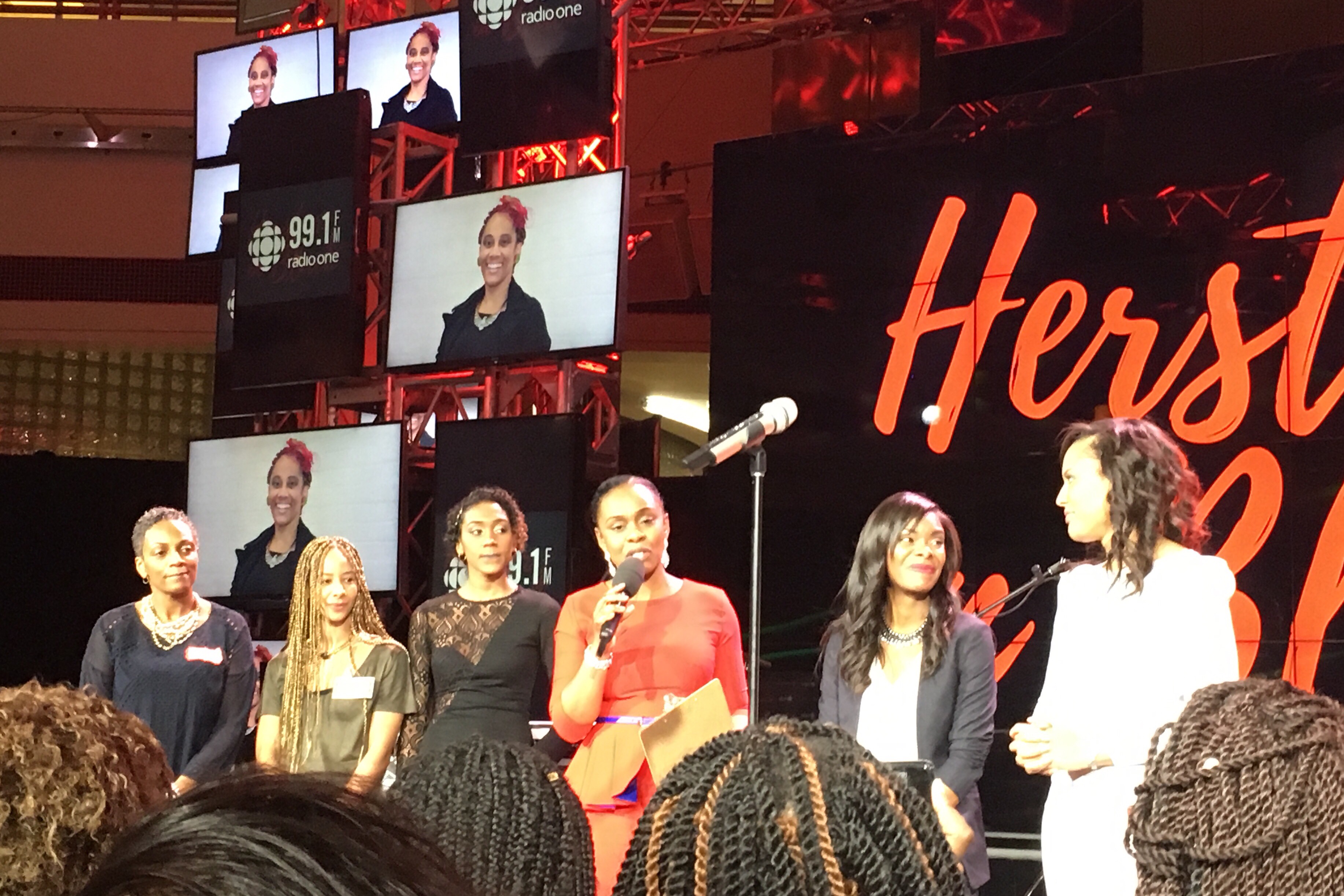
    We arrived at the CBC building around 5:30. The celebration of HERstory in Black was set to begin at 6.

    In her latest edition of Facebook Live, Emily Mils mentioned something that I had noticed. On Monday evening, I saw some male musicians and production staff. Yet both behind and in front of the cameras, HERstory in Black was clearly women-driven. How many organizations make a point of hiring us to support an event at every level where we are set to be featured as speakers or performers? Kudos to Emily Mills and the CBC for their vision.

    fullsizerender

    Our beloved host, Amanda Parris.

    Among other special appearances, D’bi Young Anitafrika  performed a poem called “Black Woman”.


    Is it any wonder that in two Instagram posts, I said that she “spoke to my soul”? This clip offers viewers a taste of an incredible piece of art. D’bi is a powerful writer. Her words meant so much to me—to all of us. I can’t even begin to explain their impact.

    Jully Black performed various songs, including “Glass Ceiling”. I’d never seen her live before. On Monday, she brought her mother on stage with her.


    That night, I met people that—until then—I had only seen online. I’m talking about women like Tanya Hayles,  Léonicka Valcius  Nam Kiwanuka  and Jam Gamble  . I reconnected with Bee Quammie  Tashauna Reid, and Chivon John . I even met Eugenia Duodo , the scientist in this segment that appeared on The National:

    Now that it’s over, I don’t know if I can capture how deeply HERstory in Black touched me. But I’ll try.

    I’ve already written about being one of very few people of colour in my town. I’m currently toying with the idea of moving to a more diverse city. I can only begin to express what HERstory in Black means to me—both the project, and its celebration.

    I think of the ladies who came out with me on Monday: Celeste, Janice, and Marla. And I think of Celeste’s 3 daughters. When I was younger, I don’t remember having many home-grown role models to look up to—if any at all. Certainly, the media didn’t seem to want to highlight us.

    Emily Mills, centre, along with some of the women who put HERstory together.

    When you’re the only one of your background who’s around, or even one of a few, it can be very easy to doubt your own beauty. You may question your power and intelligence. I know Black people who would argue that we need to look for all of those things inside of ourselves. To them, I say yes. I believe in harnessing the spark of self-love, and nurturing it from within. But mirrors matter. The stories and images from HERstory point to possibilities that we otherwise might not have considered.

    HERstory in Black has left me determined. I want the feeling that I have from my attending Monday night’s celebration, and writing about its photographers, to never end. I need to find a way to celebrate and share Black Girl Magic, not just during Black History Month, but all year long.

    Black women are accomplished. People talk about adding one or two of us to their groups in an attempt to display diversity. Yet I wonder if they understand how truly diverse we are as a whole.

    HERstory in Black offers people a glimpse of the wonder of us. And for that I will be forever thankful.

    For more information on some of the women involved in this incredible night, check the links below.

    Emily Mills – CEO of How She Hustles, Founder of HERstory in Black, Senior Communications Officer at the CBC

    Tanya Hayles – Chief Creative Officer, Hayles Creative Elements 

    Michelle Berry – Founder, Shelly’s Catering

    Amanda Parris – Educator and CBC Personality

    Tashauna Reid – CBC News Reporter

    Jully Black – Recording Artist & Speaker, Canada’s Queen of R&B  

  • Making HERstory: The Photographers

    The brainchild of Emily Mills, How She Hustles is a women’s network that’s been thriving for nearly 7 years. Their events are a celebration of sisterhood. Bringing together women of diverse backgrounds, How She Hustles encourages women to connect, and enjoy each other’s company.

    In December, Ms. Mills announced that she was working on a project called HERstory in Black. Back then I didn’t know any of the details. I only knew it involved an act of faith that hadn’t yet been actualized. Since that time, her vision has been made plain: HERstory in Black is a digital photo series celebrating 150 Canadian Black women. It is now featured on CBC Toronto’s web site. Further more, this week, the women who participated in the shoot for this historic series will also be profiled via CBC Radio, and the CBC News Network. 

    HERstory in Black is meaningful to me for many reasons. The first thing that comes to mind is representation. As Bee Quammie recently pointed out,  usually Black Canadians are taught about Black American role models. Meanwhile, our community’s trailblazers have always been right here at home. They deserve to be recognized.

    Furthermore, it’s incredibly empowering to see people who look like you succeeding. Watching their progress can give you faith enough to believe that all of your dreams are possible. When I see so many Canadian Black women out there, at their best in diverse industries, I am overcome with joy!

    So who are some of the people who helped turn this project into a reality?

    Allow me to introduce you to two gifted photographers.

    ebtinabag

    Photo credit: Ebti Nabag

    A graduate of Ryerson University’s graduate program in Documentary Media, Ebti Nabag is a visual artist who works with photography, video, and installation. Her work is motivated by stories from the average human. Nabag’s previous exhibits include Movement in Tradition: Tobe (2016), Vitiligo at the AGO (2015), Intersections (2014) featured at the Contact Photography Festival, and I Am Not My Hair (2012).

    She hopes her documentations serve as bridges between people.

    LeilahDhore

    Photo credit: Leilah Dhoré

    In 2013, Leilah Dhoré made her debut in a collaborative photo exhibition called ‘Exposed: Telling Our Stories Through Our Lens’. She is also the proud recipient of Gallery 44’s David Maltby Award. Leilah is currently majoring in Photography at OCAD University, with a minor in Art and Social Change. She continues to explore how her identity — and various layers of life experience — influence her creative mindset.

    These young women shot all of HERstory in Black’s gorgeous photos. Recently I asked them about their involvement in this extraordinary project.

    Tell me about your journey into the world of photography. What inspired you to get started?

    Ebti: I always knew I was a creative person, I just didn’t know how to express myself creatively. I could draw but I wasn’t the best at it and it didn’t come as naturally for me as it did my classmates. It wasn’t until I took a year off after my bachelor’s degree that I picked up a camera and decided to really explore the art of taking photographs. That was about 7 years ago. A few years after that I decided to get a formal education in Documentary Media, film and photography. Documentary photography has been my main interest since then.

    Leilah: I grew up with an artsy mom who encouraged me to explore various art forms. My creative childhood lead to being accepted into the Visual Arts program at Wexford Collegiate School for the Arts. I had to pursue my interest in photography outside of school through youth programs, which is how I discovered analog photography. The process of learning how to take analog photos and develop them in a darkroom furthered my appreciation for the medium and that’s where I found a passion for it. From there I decided to apply to OCAD University and I am now an undergraduate, third year Photography major.

    What was it like to take these photos and capture 150 women for HERstory in Black?

    Ebti: Insane! Looking around the room alone was extremely overwhelming. Some women I recognized from television, theatre, poetry shows, etc. Seeing women from all walks of life and hearing their stories after I captured their group photos was empowering.

    Leilah: I really just wanted everyone to feel comfortable in front of the camera and to be happy with the way I captured them. I was a bit nervous at first, but I was so overjoyed to feel everyone’s energy. We were all excited to meet each other and be there together. Being in a room full of so many brilliant, beautiful, Black women is a really intense and powerful experience in and of itself. It was a really fulfilling experience to meet and document black women on so many different career paths, especially having grown up without seeing a lot of that kind of representation.

    What do you hope people will see when they look at the images from this project?

    Ebti: That we, Black women, are glorious. These photos are a documentation of our existence, our stories, our greatness, and I really believe they should be archived. Often times Black women are misrepresented or not represented at all, and this project puts all those misrepresentations to rest.

    Leilah: I had always struggled to navigate the intersections of my blackness and womanhood and understand what my place is in a society that doesn’t appear to value black women. From celebrities like Beyoncé to millennials taking over the internet, black women have created our own platforms to express that we are realizing our own brilliance even if the world hasn’t. I believe this project is documenting just that. Aside from highlighting the diverse amazing things black women are accomplishing in Canada, I really hope people are able to recognize the shared power that brought us together and understand why this kind of project is so important.

    I’m often blown away by the way a single photograph can tell a story.  What sort of stories did this experience reveal to you?

    Ebti: Two things. One: there is no limit to what women can do when they unite. Two: I couldn’t help but think of how empowering, encouraging and reassuring hearing the stories of these women would have been for me at a young age, especially as a young Black woman growing up. That room really screamed “the sky is the limit”! Young Black women need to be exposed to these positive representations of Black women.

    Leilah: The individual photos have a different storytelling purpose from the group photos for this photo series. I believe they capture the diversity amongst black women and function to show us who each woman is as an individual. The group photos show us what black sisterhood and community can look like and the amount of passion, love, and energy that goes into making a project like this happen collectively.

    HERstory in Black is bound to influence and inspire other women. Tell me about someone who inspires you.

    Ebti: My parents. My father grew up in academia. His work ethic, drive and achievements are things I look up to. My mother on the other hand has always been a housewife. Her welcoming heart, kind soul, and love for people easily brings tears to my eyes.

    Leilah: It’s difficult for me to just name one individual. I have a particular appreciation for women who defy respectability and live as their authentic selves. There are women who spent their lives giving to their communities, and the ones who are passionate about dismantling the oppressive systems that were built to hold us back. I’ve also come to appreciate the women who aren’t the productive, educated, executives that we are told we should aspire to be. The ones who still give themselves fully and love themselves anyways because they don’t allow an inherently flawed society to define their worth. I see myself in these women’s struggles and successes; they remind me of the love and passion that drives my ambitions.

    Suppose you met a young woman who wanted to go into photography. What advice would you give her?

    Ebti: This is definitely biased advice, but it would be to document the stories of those who are unseen in the media, whose stories will never be told. I think telling those stories are what bridges humans together, and that’s what I try to do with my photographs.

    Another bit of advice would be, differentiate yourself from the rest. Photography is so broad. Once you figure out what you like to photograph, go back and see if there is any pattern in your work and let that be what makes you stand out.

    Leilah: There’s so much I could say. I think it’s important to know you don’t have to pursue a higher education to be any type of creative. Not everyone has the privilege of growing up with a family who supports their creative ambitions like I have, so I’ve always encouraged others to pursue what makes them happy. Even if you don’t think you have the means to pursue photography or that you face too many barriers, I honestly believe that if you put your intentions out there, doors will open and opportunities can come to you unexpectedly.

    Many brilliant successful creatives even find ways to create opportunities for themselves. The internet is full of resources and learning materials, and Toronto has many free programs available to youth. Depending on the type of photography projects you want to produce you can access funding through grants.

    Thank you again to Ebti Nabag, Leilah Dhoré, and of course, Emily Mills. Be sure to follow @howshehustles on Twitter, Instagram, and Facebook for more on HERstory in Black. Above all, be sure to stay tuned to the CBC this week for more programming on this incredible initiative.

  • Selfies suck.

    True story: A week or so ago, after I’d done my hair, I decided to take a photo. I picked up my phone, and put the camera in selfie-mode.

    The next thing you know, I was making a screwface at the thing, like, “What kind of [new-twist-on-old-swearword] is this?!?” My new ‘do–which was full and luscious IRL–looked like it was finna run off my head. My already-round face looked like a bowling ball.

    When I tell you about the amount of prayer and contortions I have to subject myself to in order to look at least 50% like I do in person…? Taking a selfie is hit or miss, I swear. And it often involves more misses than hits. *chupse*

    Men, this is why your GF takes 70 000 shots of herself ’til she finds the perfect one. Her camera keeps betraying her.

    #imjoking #orami #sometimesilookdifferentinagoodway #butnotalways #selfiessuck #sorta

  • Sorry? Not sorry.

    You know what?

    deskhandsolueletu

    I’m tired of people thinking that racism in the workplace isn’t actually a problem unless someone burns a cross on someone’s desk or yells, “Hey, nigger!”

    Honestly. The signs of bigotry don’t have to be that obvious in order to be harmful.

    When it comes to claims of racism and believability, writing about teaching has taught me a valuable lesson. The rumours are true: When you confront people with racism in an institution, some of them would rather be defensive than listen to what you have to say. It’s very easy for your words to be dismissed as a lie or exaggeration.

    I discovered this after I shared some of my experiences in trying to break out beyond the boarders of substitute teaching, into the profession’s full-time fields.

    Most of my feedback revealed a basic understanding that what I claimed was possible. However, some disagreed with me based purely on their privileged perspective.

    Although I’m frustrated, I’m also not a fool. I don’t know how to make a stranger understand how problematic racism is in teaching. Especially when they’re not interested in grasping the possibility.

    Racism is so pervasive within the profession that the Ontario Alliance of Black School Educators commissioned a study on it. Participants were anonymous. Yet in “Voices of Ontario Black Educators” (published on May 29th, 2015) they shared their insights regarding diversity in the educational community.

    Let’s take a look at a commonly understood truth. Regardless of background, many teachers know the profession is prone to having a cliquish culture. Teaching is a people-driven industry. In certain schools if you want to progress, you need to be perceived as a part of the “in” crowd. Those of us who are on the margins can find it hard to traverse that line. Or, as one individual stated, “[A school’s] networks tend to exclude Black and other educators of colour. Compounding the effect of being excluded from these networks is the limited ability of Black and other racialized educators to create their own networks with the same reach and impact.”

    Some of us are hyper-aware of the consequences of being an outsider. As one study participant said, “…if you are not part of the social scene outside of the school, you are not going to be chosen, recommended, included in the ‘outside of school’ discussions when transfers, new staff lists, new school hirings are being discussed.”

    During those “‘outside of school’ discussions” critical decisions are being made. When your success depends on your social connections, yet your connections do not exist, you can wind up feeling as though your career is doomed. And that feeling is not that far from reality.

    What about those who are able to progress? Surely they do not have any reason to be concerned. Some would disagree. As an educator cited in the study explained: “When I became a VP there was a stalling of my career for a number of years. I had a hard time moving to principal. I had to go through twice. One superintendent openly stated that she did not believe the experience that I had stated. I asked for an explanation and was not given one. I found that I had to stay quiet or risk not being promoted.“

    Fifty-one percent of the study’s participants noted that “personal biases about Blacks influence promotion decisions in this board”. We, Black teachers (and other teachers of colour) are aware of how our colleagues perceive us.The fact that we risk not being taken seriously because of those perceptions is demoralizing.

    Limited representation in the classroom suggests to me that Black teachers are rarely given room to obtain permanent opportunities. If and when they manage to slip through the cracks, they’re denied the chance to be promoted. As indicated in the above quotes, they may find their careers stymied in other ways. For instance, consider the examples I mentioned in my previous essay: Being relegated to substitute-only status, or repeatedly made to work with hostile students. Some of said students may be intimidating or even dangerous, depending on the school itself. I know that I am not the only teacher who has experienced this. Whether people choose to believe it or not, students’ behaviour can affect a person’s ability to teach.

    In the end, I know that my words can’t change people’s minds. They will either believe that what I’ve discussed is possible, or not. But when random members of an ethnic group collectively notice negative patterns concerning how they are regarded, that’s a problem.

    Every teacher faces challenging circumstances. Yet I feel that my research, along with the feedback I received only managed to reinforce my main point. Even (some) white teachers notice a disparity between how they are treated versus their more-melaninated peers. I’m thankful for their candor. Those who insist that racism doesn’t exist in the teaching profession are in denial.

    Photo by Olu Eletu on Unsplash.

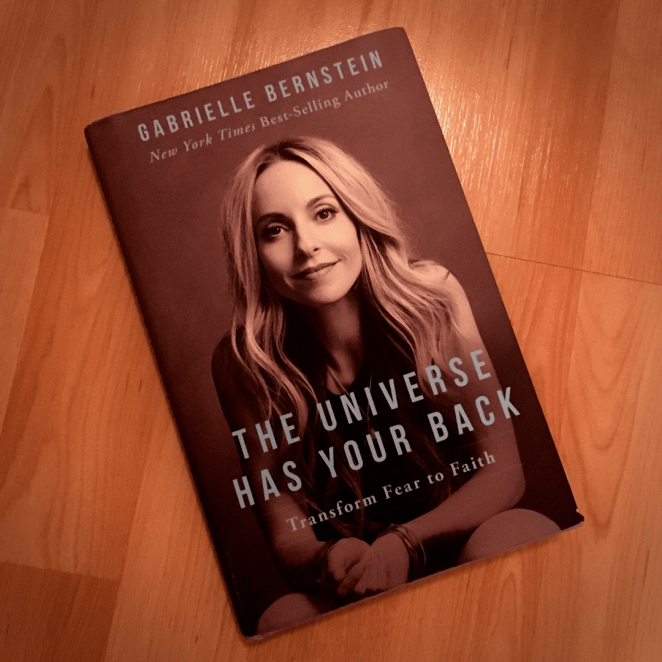
  • Read it!: The Universe Has Your Back

    I can’t begin to tell you how long I’ve wanted to review this book. I finished reading The Universe Has Your Back a long time ago.

    The Universe Has Your Back - Cover

    So what’s kept me from talking about it? Fear.  On one hand you have the fact that I’m spiritually liberal: Religiously speaking, I have a Christian background. I’m familiar with the faith. And I’m still what you would call “spiritual”. Yet I don’t believe Christianity has the only answers regarding God and humanity. Meanwhile a lot of my friends are still traditionally Christian. As I contemplated talking about Gabby Bernstein’s latest read, I could feel their judgement start before I even began.

    But honestly? I’m too old to be afraid of what a bunch of humans think. My soul’s destiny isn’t tied to them.

    Let’s get right into it. The Universe Has Your Back is fantastic. It’s the best book I’ve read about faith in a while. The content isn’t tied to any particular religion, but you can easily apply it to your spiritual path. It addresses God and faith from a general point of view.

    In the book Gabrielle Bernstein addresses one of spirituality’s biggest questions: If God (or the Universe) is as loving as we claim He (it) is, why do we give doubt so much room in our lives? Better yet, how can we banish it?

    The solution seems easy enough.We need to trust and truly believe that Jesus/God/the Universe is there for us. Period. But maintaining an unshakable faith can be challenging. Ms. Bernstein acknowledges this. Yet she also addresses the heart of the struggle, and the key to our success. We need to harness our ability to focus on one of the only things that matter in this life: Love.

    Gabby also addresses the concept of surrender—an idea that people of all spiritual stripes wrestle with. In order to receive from the Universe, we have to be willing to release ourselves from our egos. They can be one hell of a motivator. They can also separate us from what God intended.

    The Universe Has Your Back is chock full of contains meditation and reflection exercises. This is important since the road to spiritual trust isn’t simple. It’s always worthwhile, but it’s a truly humbling process. In order to succeed at it we need to dig in and do the work.

    I’m far from spiritually perfect. I wrestle with the concepts in The Universe Has Your Back all the time. But I’m glad I came across this book. I need to give its concepts the attention they deserve.

    Let the healing begin.

  • On “Black Friends”

    Demetria just about covered it.

    I read a bunch of comments about Adele on Grammy night that were ridiculous. I swear. My eyes rolled so hard, it’s a wonder they didn’t fall out of my head.

    Then, I got introspective.

    What do you hear when someone uses the words “Black friends”?

    We live in an era where people are boldly, unapologetically racist. And I get it. The words “Black friends” have been used again and again (and AGAIN) by bigots when they’re straining to be polite. “No, Jay’s Blackness doesn’t bother me. I have PLENTY of Black friends…”

    But this isn’t that.

    Like it or not, the fact remains that folks have friends who are Black. People need to learn the difference between “Black friends” as condescending tokenism and its use as an accurate descriptor.

  • Stop running.

    like-yourself

    I remember the day when those words, directed at me, hung in the air. They had been said randomly. If anyone else had uttered them, I think I would have been angry. But the speaker knew me. Not as well as I think they should, but somehow, well enough.

    “You don’t like yourself.”

    After hearing that sentence, another person might have been mad. But I was curious.

    How could this person be so sure? What were they seeing?

    Sometime last year when I was thinking about authentic self care, I realized something. There are a ton of things that I can do in order to feel whole. But do I invest in them? How do I feel about honouring my most sacred gift: myself?

    While wondering this, something else hit me. I’ve been meaning to delve into this topic for ages, but have only scratched the surface.

    Why have I avoided talking about self-care?

    Am I afraid to be still in my own skin? It’s hard for me not to think so. It’s even harder for me to admit that. But the first step in solving a problem is recognizing that you have one. So here I am.

    http://www.youtube.com/watch?v=f_K5r4uvaIo

    I’ve been running away from myself for a long time. That needs to change. And slowly but surely, it will.

  • Review: Hillsong – Let Hope Rise

    Hillsong: Let Hope Rise is billed as a “worship experience”. However, contrary to its press release, to me it didn’t feel like a part of a new genre. Let Hope Rise is, absolutely, a concert film, in the vein of Katy Perry’s Part of Me and Justin Beiber’s Never Say Never.  Scenes that offer viewers a taste of Hillsong’s story are interspersed with shots of the band in concert performing some of their most popular hits.

    I agree with one of the performers who stated that “God created music…”. Over the years I’ve enjoyed all sorts of music—including some of Hillsong’s more popular tracks. And yet, as I watched the musical segments I was torn. On one hand, I wanted to be free to love a particular song. On the other, I was reminded of what I hate about worship band performances: The idolatry. In a house of worship, when the people are gathered to sing together, they should be able to hear each other. In my opinion the only time the focus should be on a performer is when she sings a solo. Otherwise, it’s not always easy to tell who’s being glorified—apart from the singers on stage.

    I know this idea flies in the face of what one of what Joel (one of Hillsong’s leaders) said: “These songs are written for people to sing, not just to listen to.” And in fact, that is something that speaks to Hillsong’s success. Hate them or love them, Hillsong has hit songs. Their lyrics tap into a religious narrative that’s revered by people throughout the globe.

    Let Hope Rise isn’t necessarily a bore. It includes a few spare moments that revealed the musicians’ personalities. I chuckled at a line from a bandmate during an early tour: “Canada. We’re almost in America.”

    Yet throughout the film I cringed at the sight of screaming fans. I know that within Christendom there’s a celebrity culture. But ideally, so-called “Christian celebrities” aren’t here to promote themselves. It’s their Creator—who gave them their talent in the first place—that should matter the most.

    This movie also managed to include a glimpse into something that even heathen stars face: Financial challenges.  Never assume that because someone has a hit album, he or she lives in the lap of luxury. Some of Hillsong’s members still live with their extended families.

    If you come to this film looking for a thorough introduction to the Christian faith, be careful. Connecting with Jesus is not as easy as “[Finding] a local church!” This subject isn’t discussed in depth and the band’s advice shouldn’t be taken as gospel. I’m a firm believer in vetting a houses of worship before joining them.

    Hillsong: Let Hope Rise offers them a look at the lives of one of the most popular worship bands in the world. Overall, I think viewers will enjoy it.