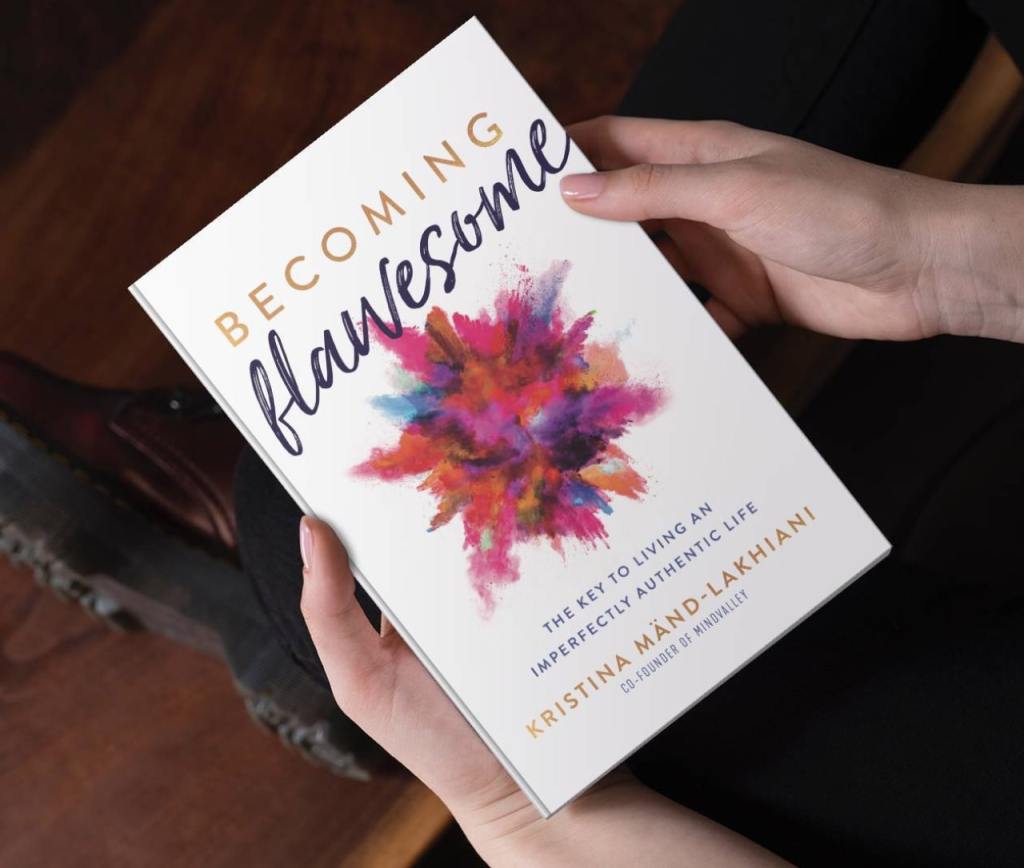
When I was first given the opportunity to review Becoming Flawsome, I was intrigued. The author, Kristina Mänd-Lakhiani, is the co-founder of Mindvalley, an organization which is, “the world’s most powerful life transformation platform”.
Becoming Flawsome encourages its readers to, “overcome perfectionism and self-doubt by unapologetically embracing your fully awesome self—flaws and all”. And as I embarked on reading the book, I was hopeful. Who doesn’t want to learn something new about accepting themselves completely?
Yet as I read, I felt a mix of emotions. Theoretically, I agreed with Mand-Lakhiani’s premise. Yet while reading some sections, I found myself disagreeing with what she had to say. In others, I felt as though she had covered territory that I was already familiar with. And both of these sentiments influenced my perspective on her work.
Certain chapters such as “Self-Care vs Self Love” may or may not resonate with readers. Therein, Mänd-Lakhiani makes an interesting case for a distinction between the two, noting that, “Self-care is about surviving, while self-love is about thriving.” (192)
That said, the examples that I’m about to discuss are indicative of some of the issues that I had with this book.
In the chapter entitled “A New Life” Mänd-Lakhiani tells her readers that, “Your only moral duty is to be happy and at peace with yourself”. Initially, I disagreed with this sentiment. I was concerned that her idea could be interpreted as one that promoted living selfishly. Truly, after a time, doing so can take its toll on your happiness and peace of mind.
In fact, I spent a portion of that chapter contemplating what the author may have meant regarding people’s “moral duty”. That is, until she eventually touched on the familiar idea that we ought to be careful as we aim to help others, because we can’t pour from an empty cup.
Those aren’t Mänd-Lakhiani’s exact words. But in self-help circles, they represent a widely-understood sentiment: You cannot hope to adequately help others, without making sure that your essential needs are met first. Yet she took time getting to this point, and once this segment of Becoming Flawsome was through, I found myself wondering why she hadn’t revealed this conclusion sooner.
Within this chapter, Mänd-Lakhiani also made a rather generalized statement about giving to others: “The world would be so much more of a better place if, instead of giving to charity out of guilt and obligation, we did good out of a sense of justice, unity, equality, and our own level of abundance.” (228) At this point, I couldn’t quite relate to her words. As far as I’m concerned, there are plenty of people who give to others out of love and a sense of altruism. In my mind, that is the norm, as opposed to the negative factors which she mentioned.
Nevertheless, one of Becoming Flawsome’s most salient points was made on page 188, via a paraphrased statement by Marisa Peer. “You are enough” is a popular sentiment in the self-help arena. And Mänd-Lakhiani wondered whether or not people risked becoming immobile or complacent because they put too much faith in the idea. Yet Peer had another perspective, explaining that “You lie back on your sofa doing nothing, not because you think that you are good enough, but the opposite—you do that because you are afraid that you are not enough. It is a fear of failure, of not being good enough, that prevents you from going out and exposing yourself to the world, doing something courageous and meaningful…” (188)
In Becoming Flawsome’s final chapters, the author makes a point which I feel overall addressed my journey with this book: “What works for some may not work for others.” (258) Its most fundamental tenet revolves around encouraging readers to develop authentic self-acceptance. Yet this is not an unpopular notion. Hence, if you’ve heard this sort of messaging before, much of Becoming Flawsome may seem familiar.
Ultimately, I remain divided in my thoughts on this book. Becoming Flawsome touches on some information that falls under the self-help genre’s fundamentals. And when you’re beginning your self-help journey, it can be beneficial to have a basic foundation. Yet if you have already read these types of books, you may find that it covers familiar territory.
Photo provided by Kristina Mänd-Lakhiani’s team.








 claire.she.goes