Category: losing my religion

  • American Jesus: Where are your priorities?

    This post was originally shared on my Medium page. Slowly but surely, I’m coming back to my own site.

    In my lifetime, I have seen clergy from all over North America bend themselves over backwards and twist themselves into pretzels, determined to despise certain people over so-called sins. Yet said sins involve behaviour that is none of their business.

    Their insistence on doing this tells me two things. First, it reveals the truth about their commitment to loving each other. Jesus himself said that we are supposed to love our neighbors as ourselves. Yet time and again, people look for loopholes.

    After all, it’s much more fun to judge others. White Evangelicals are, above all, white. Whether they acknowledge it or not, they play a role in North American society as a part of its dominant race of people. And there’s something that a number of them seem to enjoy about playing God.

    In my experience, meddling in other people’s lives is a part of (White) Christian culture. Many of them have been hardwired to believe that everyone outside of their bubble is pitiful and needs “saving”. Not just spiritually, either. The idea of Black people as inferior is embedded into the faith’s colonial heritage. Throughout history, our culture has been mined and undermined by dominant members of society.

    Secondly, the energy that they put towards hating people because of their “sins” is a declaration of their insecurity. To be specific, it reveals to me the truth about just how much they really trust God.

    If God truly hates people because of anything that they do of their own free will on their own time, He will deal with them. He is MORE than strong enough and BEYOND capable.

    I know that you know I’m right.

    Some spiritual paths refer to this as Karma.

    What you put out into the world comes back to you.

    Jesus himself said, “Do unto others as you would have them do to you.”

    Therefore, I have one question for Certain Christians: Why do you think it’s YOUR job to pursue personal sins so vehemently?

    Racist words and deeds are pure evil. In the here and now, they hurt living, breathing human beings. They can diminish a person’s spirit and deeply scar their soul. They can leave people like me questioning our sanity and humanity.

    For hundreds of years, racist WORDS and ACTIONS have done everything from putting people in SERIOUS socioeconomic jeopardy, to COSTING THEM THEIR LIVES. By words, I don’t only mean slurs. Racism is perpetuated via the way you speak to and about Black people. Microaggressions leave scars.

    And racist actions involve more than physical violence.

    Consider this diagram.
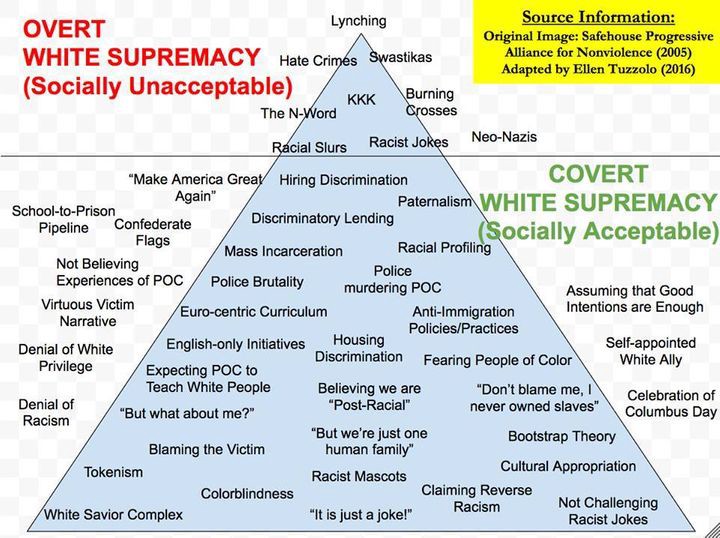
    Thankfully, over the past week or so, “Police murdering POC” seems to have moved from the Socially Acceptable category into its rightful place as being Socially Unacceptable. But take a look at the rest of the items that lie under the line near the top of the pyramid. If you’re white, do you know what all of them are? And do you understand how they can harm Black people? If not, please head over to Google. It’s time for you to start studying.

    Whether blood is shed because of it or not, racism has DEVASTATING, real-world, PRESENT DAY consequences. Yet earlier this year I had to listen to a popular pastor make a “declaration” against homosexuality. (For what it’s worth, it was a Black pastor. And I’m calling on Black church leaders, too, to have courage in the fight against racism within the church. If ever there was a time to “Tell the TRUTH and SHAME the DEVIL…” this is it.)

    Regardless of your position, if you are a Christian leader, you need to step up and recognize the power that you have. People’s world-views are dictated by what you say.

    There are adults who are in therapy because as a child, their parents led them to believe ridiculous things about themselves, in the name of God. There are people whose mental health has been shattered because so-called Christians have been determined to deny their humanity over things that are a matter of personal choice or identity.

    Yet funnily enough, what another person does in their private life has never managed to snuff out mine.

    So, I’ll ask: When it comes to the evils that you preach against, where are your priorities?

    Last week when I was first drafting this, a sentence came to me.

    If the church went after racism the way it went after certain other issues, racism would be OVER by now.

    Now, to some that may sound far-fetched.

    If so, I’d like to ask you to think of the examples that I mentioned earlier. I stand by what I said. There are people who still feel traumatized today, because in their youth, as Christians, they were humiliated over things that cause others no actual harm.

    Stop wasting time wringing your hands over other folks’ life choices. People need to feel a deep sense of shame over genuine evils that actively hurt others. And you can start with racist language and behaviour.
     

  • American Jesus: An Introduction

    Years ago, I started trying write a lengthy blog post called “American Jesus”. Its main theme is racism and religion. I’ve been reluctantly adding to it as I’ve reflected on society. 

    Living in Canada, some of the white pastors that I’ve encountered have either spoken or acted in ways that left me feeling uncomfortable. I couldn’t help notice that they modelled themselves a certain way. Specifically, they seemed interested in mimicking what you might witness in American-style, Big Box Christian circles. Hence, my title.

    This post goes out to every Black Person who has had to tolerate bigotry in a church setting. This is especially for those who have endured a white pastor who loved to show how “down” they were.

    Yet when the darker skinned people in their congregation dared to open their mouths about how they have been wronged by society—or a fellow parishioner—suddenly those people were doing too much, or just “misunderstood” something–or were just plain WRONG.

    Photo by Valerie Sigamani via Unsplash

    Years ago I lived in Toronto with a pair of roommates.  We got along well. For some reason, one day, one roommate–a woman of colour* that I’ll call Angie–and I got together and decided to take each other to church. She took me to a Black church that she attended. I took her where I went. Downtown.

    It was a white church. In hindsight I know that I was one of very few non-white people in attendance. Yet somehow, I only started taking it in after the service, when she pointed it out.

    Because of that observation, you might be tempted to feel smug. Especially if you’re reading this and went to church with me back then.

    Please don’t.

    Don’t say, “Claire, you know damn well it wasn’t a ‘white’ church.” Technically, supposedly,  everyone was welcome. The term “white” is simply a descriptor of the majority of the people who showed up.

    And please, don’t look at my sudden realization and tell me, “Ah, Claire. See how comfortable you felt. The people in that church behaved decently towards you. They took you in as a child of God.”

    Some seemed to, of course.

    However, years later, after the American election in 2016, I became aware of just how white certain members were—especially some of its leaders.

    Over the years many of us remained connected via social media.

    Hellscape that it can be, Facebook is where I saw the most garbage. The political climate is connected to the current cycle of racist evil that we are experiencing. And in the days after the election I saw a lot of interesting things.

    Please note in these examples, I’m generalizing. Mainly because I imagine other Black people have witnessed similar things. Meanwhile in real life, while drafting this, I was thinking of specific individuals.

    Among other things, via social media, I witnessed white Christian men who…

    When asked what the intentions of protesters who took down Confederate statues were, declared “I don’t know!”. As an authority, his attitude only added to the narrative that protestors must have been unhinged. He missed an opportunity to do research and recognize the statues for what they are: Symbols of oppression.

    Men who took cheap shots at Obama. Meanwhile, in the wake of blatantly evil acts from his successor, said NOTHING.

    Men who share stories from a media outlet that made Fox News look like it deserved a Pulitzer.

    Men who love to talk about what MLK would have done—because it bothered them when anti-racist protesters got violent—and after all, didn’t Dr. King hate violence?!? Meanwhile, Dr. King understood that a riot was “the language of the unheard.”

    (Dear White People: STOP using Dr. King as a prop to excuse your lazy approach to injustice. He may not have been interested in rioting, but he understood the type of hopelessness mixed with righteous anger that lies beneath.)

    Men who quoted random Bible verses without explanation. Yet the scriptures’ tone and content left readers thinking only one thing: they believed innocent people were to blame for whatever leader they wound up with.

    Men who told me, “Black people voted for Trump!” Which in hindsight, is interesting. When I first saw that comment, I shot back a word about slaves who were extra loyal to their masters.

    However today, when I hear that, I think “And a woman defended Harvey Weinstein.” Because one did, literally. In court.

    Here’s a #ProTip: Someone may receive support from those who are among their potential victims. Yet that does NOT mean that they are incapable of oppressing them. It merely makes them good at fooling the most naïve among the oppressed.

    That, and there’s a little thing called Stockholm Syndrome.

    Looking back, it hurts to realize that I turned to some of these people for spiritual leadership. (Mind you, it wasn’t a completely surrendered form of leadership. When I was a child, not only did I go to church, but my family was involved in ministry. Throughout my life, my parents encouraged me to cultivate my own personal relationship with God.)

    Nevertheless, when you go to church services—or watch a pastor on YouTube–just by showing up, you are saying that you value the opinion of the person in the pulpit.

    Black people, you need to beware of the beliefs of the people who lead you on Sabbath and Sundays. Our lives matter.


    *She wasn’t Black, but she wasn’t white, either. Hence my use of that term.

  • Watch It!: The Family

    Photo by Ricky Turner via Unsplash

    Earlier this year there was a bit of buzz related to Netflix’s new show, The Family. I took note of the fact that it would air later this year, but otherwise, left it alone. That is until a few weeks ago. One Saturday morning I noticed that someone in my social media feed had posted about the show. By that Sunday, I’d begun to check it out. 

    Thus far I’ve seen The Family once and if I have time I might watch it again. I don’t want to reveal too many spoilers, but I would like to talk about what I saw. 

    Hence, on that note, how can I best describe it?

    As the content unfolded onscreen I was…Surprised–but not completely. Just thinking about the way American politics has evolved over the years, it’s been hard not to believe that behind the scenes,  something horrible has been going on all along. And I can honestly tell you that if you’ve had any fears about religious corruption, The Family will confirm them. Although it isn’t in the horror genre, its content gave me the creeps. Overall, though, I was mostly disgusted. 

    The Family is a docuseries that recounts the evolution of a bipartisan religious organization–referred to as The Family–which has been tied to the government’s top leaders in Washington, DC. Based on a pair of books by Jeff Sharlet, the first episode begins by telling its story through the eyes of the author. In his younger days in Washington, Sharlet was first introduced to The Family via his time at Ivanwald–a household that serves, essentially, as a Christian fraternity. 

    Throughout the series several snippets of dialogue reveal the sinister nature of a movement with seemingly innocent roots. In one scene, James Cromwell, as religious leader David Coe, speaks to a group of young men. He asks them a simple enough question.

    “Can you think of anyone who made a covenant with his friends?” 

    In response, young Mr. Sharlet gave what I thought was the most obvious answer to this question. “Jesus.” However, Mr. Coe had another person in mind. 

    At this point I should note that when Coe replied, I initially thought the screenwriter was using a bit of artistic license. After all, some of The Family’s segments were dramatized. I honestly wanted to believe that Movie Coe didn’t actually use Real Life Coe’s words. And I might have, if not for the fact that The FamIly includes actual footage of David Coe standing in a pulpit. As he speaks to his audience about how to influence others, he shares his thoughts.

    “Hitler. Hitler made a covenant. The Mafia made a covenant. Look at the strength of the bonds.”

    “HITLER made a covenant”?! Watching that footage, I don’t think I’ve ever given my computer a more horrified stare.

    Truly, I was stunned. 

    Imagine. You have Jesus Christ HIMSELF, as the head of your religion. Yet when you want your followers to have an example of someone who successfully made and kept a promise to others, you choose HITLER?!  

    That bit of dialogue haunted me. It also called to mind a greater problem within mainstream religion. Time and again, certain Christian leaders try to put up a good front. Yet ultimately, they demonstrate that they don’t have genuine confidence in their faith. This tends to be revealed in challenging situations: Rather than standing by their principles, in a quest to relate to the world, some pastors rush to support evil in all of its forms.

    For some reason or another, some would rather choose fame over discernment and authenticity. 

    But I digress.  

    I already thought something was off with Big Box Christianity and its connection to the American government. In the end, The Family only confirmed my suspicions.

    Before I go, let me offer you a warning: If you’re going to view this show, you might want to mentally prepare yourself. Especially if you have any previous experience with religious fundamentalism. The Family wasn’t easy to watch. Nevertheless, I’m glad I did.

  • Status Report?: Spiritual Renewal

    Earlier this summer, one of the hottest musicians in the galaxy mentioned prayer in an interview, and I felt it.

    When I first read Rihanna’s chat with Sarah Paulson, I was excited. I had just shared a post on meditation. Next on my schedule was prayer, but I needed a hook. Perfect timing, right?

    Except it wasn’t.

    Something was wrong with me. 

    As a writer, over the course of this year I’ve had doubts about my skills. And as I looked at tackling spirituality, I felt more intimidated than inspired. The thought of writing on God opened infinite possibilities. Yet how can someone possibly quantify something that’s immeasurable?

    Thankfully, not too long ago, I faced a genuine moment of divine intervention.

    One day, rather than feeling a sense of intimacy with God, I felt overcome by the weight of an incredible distance. It was an odd, painful encounter. And of all the things in the world, while listening to a gospel track, I started to sob.

    Looking back on that moment I recognize that I was pretty much the epitome of a religious cliche. But at the time, I felt as though a door had opened. I started asking myself questions. Was I dreaming, or when I was younger, did I have a more authentic spiritual practice?

    Lord knows (no pun intended), over the past few years, something has felt different.

    And so, back to my origins I’ve returned.

    Mind you, as I go, I’m still discovering what this means. Yet the loss of people such as Rachel Held Evans has reminded me that there’s work to be done. In this political climate, the theologian within still wants to call people towards a more conscientious vision of Christianity.

    Overall, I’m not comfortable with any form of piety that denies our common humanity. I really want to dive into religion and some controversial material. But that’s another post for another day.

    And so, until next time… Here’s the last sermon I watched. Pastor Furtick offers a decent riff on the idea that man contains multitudes.

  • Review: Hillsong – Let Hope Rise

    Hillsong: Let Hope Rise is billed as a “worship experience”. However, contrary to its press release, to me it didn’t feel like a part of a new genre. Let Hope Rise is, absolutely, a concert film, in the vein of Katy Perry’s Part of Me and Justin Beiber’s Never Say Never.  Scenes that offer viewers a taste of Hillsong’s story are interspersed with shots of the band in concert performing some of their most popular hits.

    I agree with one of the performers who stated that “God created music…”. Over the years I’ve enjoyed all sorts of music—including some of Hillsong’s more popular tracks. And yet, as I watched the musical segments I was torn. On one hand, I wanted to be free to love a particular song. On the other, I was reminded of what I hate about worship band performances: The idolatry. In a house of worship, when the people are gathered to sing together, they should be able to hear each other. In my opinion the only time the focus should be on a performer is when she sings a solo. Otherwise, it’s not always easy to tell who’s being glorified—apart from the singers on stage.

    I know this idea flies in the face of what one of what Joel (one of Hillsong’s leaders) said: “These songs are written for people to sing, not just to listen to.” And in fact, that is something that speaks to Hillsong’s success. Hate them or love them, Hillsong has hit songs. Their lyrics tap into a religious narrative that’s revered by people throughout the globe.

    Let Hope Rise isn’t necessarily a bore. It includes a few spare moments that revealed the musicians’ personalities. I chuckled at a line from a bandmate during an early tour: “Canada. We’re almost in America.”

    Yet throughout the film I cringed at the sight of screaming fans. I know that within Christendom there’s a celebrity culture. But ideally, so-called “Christian celebrities” aren’t here to promote themselves. It’s their Creator—who gave them their talent in the first place—that should matter the most.

    This movie also managed to include a glimpse into something that even heathen stars face: Financial challenges.  Never assume that because someone has a hit album, he or she lives in the lap of luxury. Some of Hillsong’s members still live with their extended families.

    If you come to this film looking for a thorough introduction to the Christian faith, be careful. Connecting with Jesus is not as easy as “[Finding] a local church!” This subject isn’t discussed in depth and the band’s advice shouldn’t be taken as gospel. I’m a firm believer in vetting a houses of worship before joining them.

    Hillsong: Let Hope Rise offers them a look at the lives of one of the most popular worship bands in the world. Overall, I think viewers will enjoy it.

  • Books: Brazen

    Books: Brazen

    brazen-cover-sept-12-2016I remember when I first read Brazen. After an evening out, my copy was at home waiting for me. Earlier, I’d gone to Paris Lectures–an event where I’d shared some of my dreams in front of a hometown crowd. Since then, I’ve paid close attention to my struggle to keep my aspirations alive.

    Overall, Brazen focuses on the impact that self-doubt can have on us as we pursue our goals. It takes faith to beat a doubtful spirit: Our passions are a gift. We need to cultivate them.

    In Brazen, the author explores the connection between our dreams and the ways that we view and receive God in our lives.

    This book may not be for everyone. Fundamentalists probably won’t like the author’s easygoing tone, or the fact that she mentions yoga. They may even hate that her book is interactive, complete with exercises involving a Brazen Board (the author’s version of a vision board) at the end of each chapter.

    While reading Brazen, I frequently stopped to underline passages. I enjoyed scrawling page numbers at the back of the book, knowing that I would look at them later on. The author offers her readers many rare gems. For instance: One of Brazen’s chapters contains a good, solid word about clutter and self-care. I’d never thought about those two issues related quite in the way the author explained them. Quite honestly, those pages alone would have made Brazen worth its price if I hadn’t gotten my copy for free.

    As far as I’m concerned, Brazen’s author did her job. In this life, you need to be Brazen and honest about what you want. The best way to do that is by being your most authentic, God-given self.

    Disclosure: Brazen has been provided courtesy of Baker Publishing Group and Graf-Martin Communications, Inc.


  • Rise & Shine

    Remember when I posted a few days ago about feeling the push to pursue my dreams vs fear? When I said “signs are everywhere” …?

    This sermon is one of them.

    Happy Sunday!

  • Introducing – No Shame Movement

    Introducing – No Shame Movement

    In the past, I’ve been told it isn’t a good idea for me to write about about religion. But I can’t help it–I’m drawn to spirituality. It’s a huge part of people’s lives. Here in Canada, only 23.9 percent of the population claims to not have some sort of religious affiliation. Therefore, those who believe in (a) God are in the majority.

    Whether it’s discussed or ignored, religion has tremendous cultural and personal power. Most people’s understanding of the divine likely colours the way they view themselves and others. Faith also has the power to determine the way folks perceive every part of their lives, including their sexuality.

    When religion has a healthy influence over the way someone sees relationships, it can promote a deeper level of things such as commitment and self-care. When its impact is unhealthy, it can lead to distorted ideas concerning oneself and others. Among Christians, this negativity can manifest itself through purity culture, an entity that

    …encompasses the emphasis on virginity before marriage and on maintaining emotional purity that pervades fundamentalism and evangelicalism, made visible in purity balls, purity rings, purity pledges, and modesty teachings. These teachings are not limited to fundamentalism and evangelicalism, and can be seen in the culture at large with the slut/virgin dichotomy and the prevalence of abstinence only sex education in public schools. In its most extreme, the purity culture involves giving up dating for a return to parent-guided courtship, and even arranged marriages.*

    Fortunately, some are daring to turn the tide. Not too long ago, I got in touch with Lola Prescott, creator of No Shame Movement, a platform committed to countering purity culture’s stifling hold on Christianity.

    no-shame-movement

    I asked her some questions, and I’m very thankful for the opportunity to share her thoughts on my blog.

    What’s your religious background? Were you born into a church family?

    I grew up in a Christian household, around conservative evangelicals and Pentacostals. I also attended Christian schools during my preteen and teen years.

    Growing up, what were you taught about sex?

    Explicitly, I was taught to believe that sex is a gift from God to be enjoyed between husbands and wives. Implicitly, I learned that sex was something that men do to women: Men want sex and women must do everything they can to keep them from getting it.

    Any discussion of sex outside of marriage was considered disgusting. For instance, TV characters who talked a lot about sex were thought of as “raunchy” and cast in a negative light.

    Policing or shaming people’s sexuality is an integral part of purity culture. Can you give me an example of a purity culture tool that you think has been especially harmful?

    [Purity culture] infantilizes teens and young adults. They’re taught to “avoid temptation” in a variety of ways instead of learning how to set healthy boundaries and communicate with their partners; it also doesn’t teach the concept of consent.

    It’s harmful because it has resulted in a whole generation of Christians who have no idea of how to have a healthy relationship and believe they’re “damaged” [because of] any physical activity they’ve engaged in outside of a heterosexual marriage.

    When it comes to myths that some Christians perpetuate about sexuality, what do you think is the biggest one?

    You’re either Chaste-y McVirginton or you’re a sex fiend, running around having sex with any and everyone. Also, [there’s] the notion that having sex outside [of] a hetero marriage will ruin your life…When you’re told consistently that sex will result in heartache and depression, it becomes a self-fulfilling prophecy.

    Suppose someone tells you that we need “purity culture” to keep us on the right track in our Christian walk. What would you say to them?

    I have a website full of receipts that say otherwise. One of the main reasons I started NSM is to have a place for people to share stories. It’s easy to argue with one person, but a multitude of people sharing stories with a common theme is harder to ignore.

    In terms of deconstructing or destroying purity culture, what do you think people can do? Do you think it’s possible…? Better yet, how can people heal from its influence?

    It is definitely possible, but it’s an ongoing process. People [need to] start with educating themselves. Many people who grew up in purity culture are woefully uninformed about sex ed. Get to know your own body and discover what you like and don’t like. Be patient with yourself. Recognize whether or not you’re ready to be sexually active, and don’t be afraid to communicate that clearly with your partner.

    Also, [it’s important to] talk to people who share your experiences.

    The bottom line is to understand that the things that are best for YOU don’t necessarily equal things that are best for ALL.
    How can people find out more about you and the No Shame Movement? What’s your URL, social media handle, etc.?

    You can visit noshamemovement.com for more info. We’re also on Twitter @noshamemov, as well as Pinterest, Facebook, Instagram, and Flipboard.

    Thanks again to Ms. Prescott for her time.

    *Definition taken from The “Purity Culture”–a definition and resource list on pathos.com

  • “Say YES!”

    I don’t know about you, but I want Destiny’s Child to return. When they come back, they can do anything they want–gospel, soul, rock ‘n roll. I don’t care! I just need them in my life.

    I love this song so much!

    As you go into this week, keep your eyes on the prize. You’ve got what it takes!!

  • Dear Conservatives: Do Better.

    I’m disgusted…

    I’ve been thinking that I ought to get back into my blogging groove for a while. Over the weekend, I started organizing a list of topics. My days were set. (Sorry I’m late. 😉 ) The first thing I wanted to share with you was my take on an article I’d found via a link on Christianity Today’s website. The topic? Child abuse.

    I’ll get to it later, though. Earlier today, I began to watch this interview featuring Jim Bob and Michelle Duggar.

    https://www.youtube.com/watch?v=sNEPOmH8dH8

    In case you’ve decided not to watch, Mr. and Mrs. Duggar were being questioned by Megyn Kelly about their son Josh’s abuse of their daughters. I’ll admit it: My viewing experience didn’t last very long. Almost immediately after I pressed “play” on that video, my shoulders tensed up. As I listened to Ms. Kelly’s questions and the Duggars’ replies, something didn’t seem right to me.

    For now, I’ll spare you my thoughts on that “something”. Instead, I’ll talk about the point when I decided I’d had enough.

    Around almost 7 minutes into the interview, Megyn asked Mr. and Mrs Duggar if they’d considered turning their son in to the authorities.

    Cut to Jim Bob’s answer.

    “As parents, you are not mandatory reporters.”

    I couldn’t go on much further after that.

    Mr. Duggar believes that parents are “not mandatory reporters” of abuse. He does not think that they should feel obligated to tell the police if their children have been abused. Needless to say, Mr. Duggar’s words left me feeling a mix of disgust and worry. There are already countless abusers in the general population. Along with them are parents who either know about instances of abuse, or suspect it. How many of them will watch Jim Bob, hear what he says, and fail to protect their children because they don’t believe that they’re obligated to do so? How many are already doing nothing, and now feel justified by his claims about the law?

    More importantly, what do conservative Christians–and even as I say that, some conservative Christians, because I can’t believe that all of them are that ignorant–have against doing the right thing?

    The article I mentioned earlier disturbed me for one simple reason. (Feel free to read it here. Note that it was published before the Duggars’ interview, yet its content supports their line of thinking.) In spite of its seemingly neutral wording the only thing I understood was that it perpetuated a very harmful message.

    If you don’t want to report abuse, remember that there are states where you can get away with keeping quiet.

    I want to know: Where does this need to protect abusers come from?

    Abuse victims deserve more than what some folks are willing to give in terms of integrity and justice. I can’t tell you how sad it is to me that in instances of abuse, certain Christians forget that

    …your body is a temple of the Holy Spirit within you, whom you have from God…

    (From 1 Corinthians 6: 19)

    Every human body is sacred. It’s hard for me not to notice how quickly some remember that when complaining about a host of supposed worldly evils. Yet when it comes to protecting abuse victims, suddenly, they can’t be bothered.