Category: Film

  • Superman and The Manosphere’s Superhero Complex

    Superman and The Manosphere’s Superhero Complex

    Photo by Esteban López on Unsplash

    For ages, offline, I’ve been writing and wanting to share some of my thoughts on what’s been bothering me about the manosphere. The latest version of my work contains a few segments, and this post is inspired by one of them.

    I’ve noticed a curious trend in the critiques of James Gunn’s latest film, and rather than offering a long preamble, I think I’ll cut to the chase.

    Looking into why people don’t like Gunn’s version of Superman brings up articles like this one. (And in my list of search results, I couldn’t help but notice a piece entitled, “They’re Literally Angry at Superman for Being Nice”–something that I might read, even though I’m pretty sure the writer and I are on the same page.)

    Superman–as depicted in James Gunn’s latest film via David Corenswet–troubles many Big C Conservatives and their acolytes because he violates a core tenet of the manosphere. 

    Specifically, this:

    Physically fit, good looking men are NOT supposed to demonstrably (earnestly) care about, or be sensitive towards others. (Here, of course, “others” refers to those members of humanity who are vulnerable or likely to need their help–or, hell–are just people who may be different from them, and therefore have experienced life differently.) These men don’t need to practice kindness of any kind in order to get what they want out of life.

    And if a man is white, that rule goes double for him, and six times on Saturdays.

    But Claire–you say–what are you talking about? When has one of the Manosphere’s Leaders–herein, otherwise known as Podcast Bros–dared to utter such a thing out loud?

    Well, it may not have been explicitly said, but time and again, such a guideline has been HEAVILY implied and encouraged.

    Within the manosphere’s media, individuals and causes that require sensitivity, depth, and nuance are mocked. You could be talking about the environment, race or racism, equality…

    (And by the way–the way some of the leaders of the Dudebro Dynasty used false rhetoric over time to slander the concept of DEI needs to be studied…) 

    Time and again, ANY call for men to help or generally understand and accept various members of humanity is depicted as laughable and somehow beneath what “REAL” men ought to be interested in.

    Men who demonstrate any sort of sensitivity to others–such as women–are called names like “cuck” and at least one other term that escapes me as I type.

    Meanwhile, those who tell the truth about what the rest of humanity would appreciate in men are vilified and treated as The Enemy. 

    Womanese

    I remember a few weeks ago, I saw a video wherein a man noted certain qualities that he expected from a woman in a relationship. In return, the woman shared her hopes concerning a partner.

    And what did the man say in response? He declared that she was speaking “womanese”–as in some sort of foreign, woman-specific language.

    In return, I thought, “Pardon me, sir. But don’t you want to end up with a woman? Shouldn’t you care about how we think or what we genuinely desire?”

    Within the manosphere, Dear Reader, I MUST ask: Where is this desperate need to make normal things sound repugnant coming from???

    Never mind. I’m getting away from myself. 

    One thing that I want to point out is that intentionally casting everyone that isn’t A Certain Type of Man or Person as The Enemy isn’t getting these men where they think it is.

    And indeed, as I was saying–my main grievance at this time stems from the fact that within the manosphere, the most basic of human traits connected to kindness–an INTRINSIC and VERY popular human value–are lied about and portrayed as antithetical to what men should aspire to. 

    If you don’t believe me, let’s consider how the manosphere regards the “s” word, aka something that’s–judging from their reactions–one of the most wretched of all things in this world:

    Safety.

    Everything is… AWFUL?

    Let’s kick off this part of my discussion with a little comedy, shall we?

    Take a minute and watch this.

    I remember the first time I saw “The Official Woke List”. I thought that whoever came up with it deserved All of The Awards.

    Seriously.

    All great comedy contains grains of truth. And watching the podcast host receive Colin’s litany of “woke” offenders reminded me of some of the top Manosphere Leaders’ content. Over time I’ve noticed they’ve been heavily invested in warning their audiences about society’s supposed dangers. 

    And did you notice what “Colin from Portsmouth” shouted at 0:47?

    You can run it back if you want… 

    Among all of the things that he listed as “woke” and detrimental to civilized society, he barked

    “PLACES WHERE PEOPLE FEEL SAFE!!!”

    Now, I’ve seen the way Podcast Bros discuss safety, and in particular, people’s desire for safe spaces. Watching them, you might believe that safety and safe spaces are something needed by people who are mewling, immature, or inferior. Meanwhile, within society, who tends to speak openly of needing a safe space?

    Nearly anyone who isn’t a straight white male.

    And in saying that, I can’t help but think about what I believe people are after when they (we) say they want a safe space–or just to feel safe. 

    Which makes me ask the following:

    If you’re a man who’s reading this, whether alone or around others, don’t you appreciate being in places where you are

    • Genuinely listened to–especially during your most vulnerable moments
    • Taken seriously
    • Respected
    • Comfortable, not made to worry or needlessly feel stressed
    • Not at risk of being baselessly ridiculed or criticized
    • Not at risk of being attacked–physically, verbally, or otherwise

    I could go on. But don’t you (men) want to be able to experience this sort of social decency–for lack of a better term? 

    Why, then, depict safety as some sort of monstrous enemy?

    I don’t mean to lump all men into the same massive stereotype. But for the most part, I could argue that a large percentage of them don’t have to worry about being disrespected or feeling unsafe to the degree that other people do. 

    Perhaps that’s why certain Podcast Bros have so successfully portrayed the concept of purposely seeking safety as ridiculous. Because so many of their audience members can’t fathom something that, as adults, they haven’t necessarily needed. Or at least had to consider to the extent that others do.

    Nevertheless, I’ve been alarmed by the lack of maturity the manosphere has displayed regarding this subject. Just because you don’t need something, that doesn’t mean it isn’t important to someone else. Especially when that someone is more vulnerable than you are.

    And yet…

    By now, if you’re a heterosexual man and you’re reading this, and you still don’t understand why other people value safety, I’m going to offer you the following illustration. Take a moment, and ask yourself: What’s your relationship like with women?

    I’m not even talking about long term relationships, or how frequently you date. Just think.

    Do women find you attractive? Do they simply enjoy being around you? Do you appreciate their attention?

    If you answered those last few questions with a “yes”, then know this: If women didn’t FEEL SAFE around you, then they (we) wouldn’t want you within a thousand miles of them. Period.

    Understand: Contrary to what the Podcast Bros have been spewing, the word “safe” and its derivatives aren’t some funny, loopy buzzwords. And safety is not just a human right. It is a human value. Something that most human beings genuinely appreciate, on a molecular level.

    Anecdotally speaking, I’ll tell you–a few days ago, I saw a social media post where someone asked women–apart from material factors such as money, what did they really want in a man? 

    “Safety” and its cousins–words relating to kindness and sensitivity came up time and again. 

    Meanwhile, for some reason, Podcast Bros seem dedicated to encouraging men to be the antithesis of what is needed for them to succeed in their interpersonal relationships–romantic and otherwise. 

    Isn’t it Ironic?

    Don’t you think?

    While working on edits for another story, it hit me: The Men of the Manosphere provide their mostly (white) male fans with THE ULTIMATE Safe Space. 

    Really. Think about it.

    Their takes on humanity’s pressing issues fall on the ears of a large, attentive audience. Their views are supported and thus far haven’t been questioned in a way that inspires them to change course.

    All the while, the information that the Podcast Bros share encourages men to remain culturally impotent. Through their programming, the public sees the hosts modeling behaviour and using language that encourages their audience to believe that it’s fun and badass to be ignorant of others’ basic needs.

    And yet, in spite of their eagerness to support popular lies about their chosen topic(s), they have the gall to regard others with dismay and disdain.

    Why?

    Because, apparently, the mainstream doesn’t appreciate their “special” knowledge and how they conduct themselves.

    But is that really what’s wrong?

    Or, could it be that various individuals like me tend to avoid Podcast Bros and their True Believers because they’re committed to upholding ignorance?

    In all seriousness, their loyalty to these men’s ideologies is downright frightening. In the end, I wonder what dividends these men’s blind fealty to the Dudebro Dynamos is yielding in their relationships, apart from frustration.

    And on a personal level, is it any wonder that certain men end up like Colin from Portsmouth? He sounded so angry, and his portrayal would have been truly comedic if I wasn’t willing to bet everything that it was grounded in reality.

    When you’re invested in thinking the worst of others for absolutely no good reason, just how good can you expect your mental health to be?

    My Point? And Perhaps Superman’s

    Human beings are powerful. Men, in particular, are powerful. This is absolutely NOT a bad thing in and of itself.

    Yet so many men are wasting their abilities and energy, and tying themselves into knots by engaging in counter-productive habits such as insisting that the most normal and benign of human traits are their enemy. They end up judging their fellow human beings accordingly, and needlessly damaging their connections with others. 

    Yet in reality, it’s their attachment to weaponized ignorance that is hurting not only humanity on a broad scale, but them as well.

    The manosphere’s leaders seem to think it’s a shame that men aren’t loved or appreciated the way they used to be. (Not since the proverbial good old days, anyways.) And yet all the while, they leave out the fact that genuine love and appreciation are a result of reciprocal interaction.

    From what I’ve observed, the manosphere teaches men from a selfish space–that they deserve God knows what (*gestures broadly*) merely for existing. Meanwhile in reality, it’s vital to remember a timeless truth: At the end of the day, people are loved for how they treat others.

    And contrary to what contemporary society likes to trick too many of us into believing, attention is NOT love.

    Or, put into superhero terms: Superman isn’t a sensation simply because he’s good looking and has powers. He is genuinely loved because he actually cares about and uses his powers to help others.

    Meanwhile, the manosphere has their followers sulking over a lack of superhero treatment, while encouraging them to offer their fellow humans less than the bare minimum. 

    I’m longing for the revolution: The days when the manosphere movement’s leaders and followers awaken and realize that ALL human beings deserve better–including them.
  • Watch It: American Fiction

    Watch It: American Fiction

    Note: This post contains minor spoilers.

    On Sunday night while American Fiction was winning the Oscar for Best Adapted Screenplay, I was watching it on my computer. The movie’s on Amazon Prime, and when I selected it, it was purely a coincidence. While I didn’t feel like watching the Oscars, I kept seeing Issa Rae, Sterling K. Brown, and more of its stars in my Instagram feed. I only realized why they were hitting the red carpet after I pressed play.

    As for the movie itself, you may or may not have already seen the trailer.

    The Plot

    American Fiction tells the story of Thelonious “Monk” Ellison, a professor and author from Boston. He’s hit a bit of a rut in his career—a lull, if you will. He hasn’t sold a book in ages. That is until one day he witnesses the success of a novel by a fellow Black writer.

    It’s impossible for Monk not to notice the seemingly stereotypical portrayal of Black people and their circumstances in his peer’s work—along with its staggering success. Eventually, Monk recognizes that he needs to swallow his pride if he wants to pay the bills. He decides to throw his hat into the Popular Black Fiction ring by writing a book of his own—My Pathology My Pafology. In order to preserve his professional reputation, Monk releases this new volume under the name Stagg R. Leigh.

    My Many Thoughts

    We live in an era where the desire for authentic representation of Black people and other diverse voices is abundant. And across a host of industries, publishers and producers have been eager to answer audiences’ requests. Meanwhile, I’ve been noticing the quality of representation that’s available. I can’t help but love the playful and serious ways that American Fiction asks viewers to consider how Black people are portrayed in media.

    One thing I enjoyed about this movie is that it’s not solely a hard-hitting satire. I genuinely enjoyed the scenes featuring Monk and his family. Their interactions added a warmth to the story that might have been absent if it had remained focused on his professional pursuits.

    As for the script itself, what is it that people say these days? “Ten out of ten, no notes”? When you watch American Fiction, you’ll see very easily why it won an award for writing. The dialogue never disappoints. It was clear to me that writer-director Cord Jefferson heard that classic instruction to “make every word count” and actually listened. Throughout Fiction his work is consistently sharp, poignant, and never boring. Even before I knew the reason for its Oscar win, I kept asking myself, “Who wrote this movie?” And I scream-laughed several times.

    My only nitpick? My inner critic wanted to offer a minor rebuttal against a character’s comment on the word “potential”. I won’t get into detail about how it’s discussed. But I will say that I’m reluctant to cast this word in a negative light. Prior to the way it’s highlighted in this film, I mainly thought that people used “potential” when speaking about something or someone that possesses undiscovered excellence.

    Incoming spoiler: As seen in American Fiction‘s trailer, although Jeffrey Wright’s Monk writes My Pafology as a joke, it’s embraced in literary circles and is quickly published. Meanwhile, along with a small group of other writers, Monk is asked to judge a set of books for a literary award.

    And guess which book becomes the top candidate for said award?

    Among the judges, Monk and the sole other Black author aren’t comfortable with Stagg R. Leigh’s book. Yet after they state why Leigh’s work is unacceptable, a well-meaning white female character pipes up and says, “I just think it’s essential to listen to Black voices right now.” In response, I laughed, sighed, and said to myself, “Oh my God. Nooooo!”

    How many times have I heard or read that sentence—or something like it—over the past few years? And why does it drive me crazy?

    It calls to mind a trap that too many people fall into: The belief that in the pursuit of diversity, all art ought to be publicized and praised—even when the vision behind it seems skewed.

    Which begs questions like: Who controls the sharing of stories about Black people? When approving Black-focused art, what are gatekeepers’ expectations? What kind of preconceived ideas do they have about what Black people are actually like? What, if any, trends are there in what gets approved? And what can be done to ensure that a variety of voices are able to speak?

    In a post- Black Panther and Woman King world, I know that some people might think stereotyping is a problem from the past. But consider Cord Jefferson’s answer to the first question in this interview.

    There are people currently producing movies who have limited ideas about what Black people are like. And not only do these people produce movies, there are likely also people who think this way who are studio heads—able to determine which projects go into production in the first place.

    Not to mention the number of people who let the art that they consume determine their expectations. Regardless of whether you depict people as rich or poor–high or low class–unbalanced portrayals of people from diverse backgrounds often influence viewers’ real-life perceptions and behaviour.

    But I digress.

    American Fiction is an unapologetically critical look at media makers’ insistence on embracing limited ideas in spite of the varied realities of Black lives. I’m glad that this film was made. As Cord Jefferson’s directorial debut, it was brilliant, and I look forward to seeing what he does next!


    Stock Photo by Thibault Penin

  • Thirteen Lives: Quick Commentary

    Thirteen Lives: Quick Commentary

    No spoilers, just vibes.

    I’ve seen a video or two on Thirteen Lives where director Ron Howard mentions not going to ridiculous lengths to soup up the film’s story, and I’ve gotta say. That was one of the best things about the movie.

    Apart from a documentary, Thirteen Lives probably marks the first time that I’ve seen a real story told truthfully in a scripted film—or at least, as truthfully as it can be in two and a half hours. I was relieved to see that while watching, I didn’t have to endure any manufactured Hollywood BS. The film’s producers seemed to be genuinely interested in presenting an honest depiction of the people of Thailand and what they went through in 2018. Back then, the story of how a team of young Thai soccer players was rescued from a flooded cave grabbed headlines around the world.

    Thus far, the only major differences I’ve read about between the real cave rescue and the film’s contents relate to the number of divers actually used and the amount of visibility that they had while working in the caves.

    In the past I’ve seen my share of movies that are “based on a true story” only to be disappointed by the changes producers and directors made in an attempt to woo audiences. More than once I’ve looked into the source material for said movies and thought, “The real story is drama enough.” I hope that Thirteen Lives’ artistry and success will inspire the people who work behind the scenes in entertainment to consider the fact that real life is intriguing enough on its own. There’s no need to manufacture nonsense in order to impress anyone.

    I certainly felt this with the true story of what took place in the Tham Luang cave. There’s a significant detail from the real-life rescue mission that was used as a plot point in the film. It’s something that people in the general public might not have been aware of. And that detail provided me with plenty of suspense all on its own, without any window dressing.

    Undeniably, people love to go to the movies in order to escape or immerse themselves in a fantasy. Yet when it comes to real events, you don’t have to lie in order to make a story interesting. Do your best in the retelling, and the truth will sell itself.


    Image via Jakob Owens on Unsplash

  • My CaribbeanTales Giveaway

    My CaribbeanTales Giveaway

    I’m giving away tickets to the CaribbeanTales Film Festival. Check my video for details!

  • Coming Soon!: CaribbeanTales International Film Festival

    Coming Soon!: CaribbeanTales International Film Festival

    Caribana may have finished, but in Toronto, the celebration of Caribbean culture isn’t over. The city is home to CaribbeanTales, an organization devoted to sharing stories from people of the Caribbean diaspora. The CaribbeanTales International Film Festival begins in September, and runs from the 7th to the 17th of the month.

    CTFF-Logo-LARGE

    A few days ago I spoke with its founder, Frances-Anne Solomon. Ms. Solomon is an award-winning filmmaker of Caribbean heritage. A writer, producer and director in film, TV, Radio and New Media, her career includes a 13-year tenure in England with the BBC as a Television Drama Producer and Executive Producer. In 2000, she returned to Toronto where she continued to create her own projects, and in 2001 she successfully launch the first CaribbeanTales project.

    Today, CaribbeanTales has grown into the CaribbeanTales Media Group — companies that produce, market and sell Caribbean-themed audio-visual content across the globe.

    FrancesAnne-JohnReid

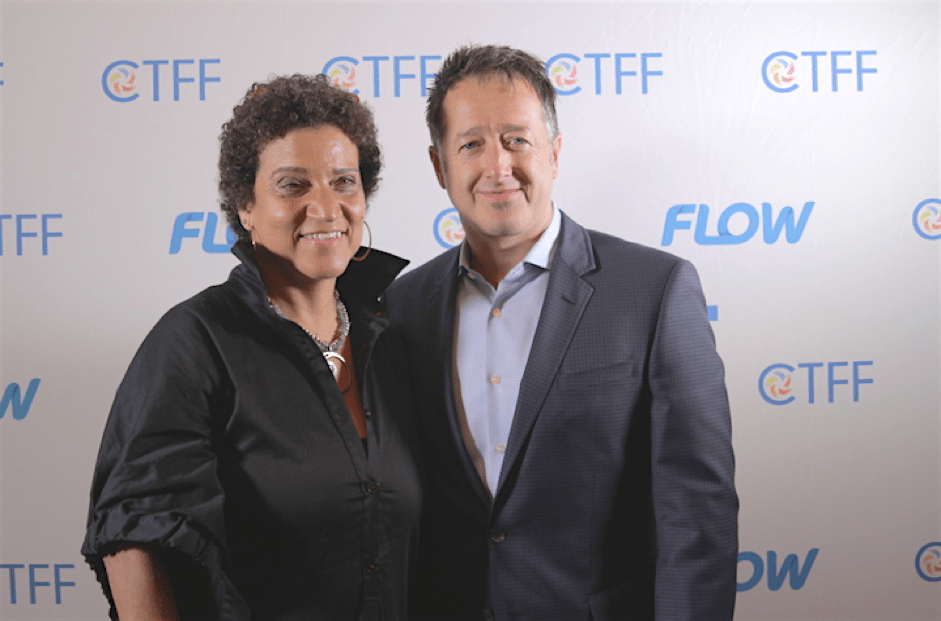
    Frances-Anne Solomon and John Reid of Flow, CaribbeanTales’ leading partner.

    Frances-Anne Solomon’s passion for telling Caribbean people’s stories is palpable. Listen to her speech from the launch of this year’s Festival.


    Ms. Solomon’s words left me feeling energized, and eager to preserve my cultural roots.

    Our chat began with her revealing what sparked her interest in film, as well as the story of CaribbeanTales.

    When I was growing up in Trinidad there were no stories about me anywhere. We learned about the kings and queens of England and history, and we learned about Shakespeare and Jane Eyre…I had to become an adult before I learned about slavery. It was only much later that I realized that we resisted slavery—that we had this incredible journey as Caribbean people coming from all over the world, and it really transformed my life.

    I remember learning this from a therapist: If you see yourself as a victim or you don’t have a sense of the beginning of the story, then that determines the ending. Whether there’s a happy ending or a tragic ending has a lot to do with how the narrative is perceived.

    I became passionately interested in storytelling and I was drawn to film. Then I worked at the BBC for many years. I got to see how the developed world could have an organization that created, produced, marketed, and sold to a rapt audience its own stories about themselves. I saw how that created national pride and individual pride—a concept of empire and power. I really felt that we in the Caribbean needed to have those sort of narratives, and mechanisms for the transmission of those narratives folded into our culture.

    In 2001 after I left the BBC I started CaribbeanTales with that goal of creating an organization that would create, produce, market, and sell Caribbean stories, of Caribbean people—Caribbean narratives of all kind.

    Originally we were making programs, and in 2006 we started the festival because programs we were making were not getting seen.

    In 2010 we started CaribbeanTales Worldwide Distribution. I realized it wasn’t enough to make films and show films, it was also necessary to be able to sell them, so that we as filmmakers and storytellers could have sustainable careers.

    Then in 2013, we started our online platform: CaribbeanTales TV. We also have an incubator program which is a hub of development and production.

    Now the whole project has is beginning to take off, and that’s very exciting.


    Twenty-sixteen marks the festival’s 11th year. How has your vision for CaribbeanTales evolved?

    My journey has been very much one of an individual—from being a story-teller, and a filmmaker to being someone who is interested in creating and changing the world—to provide a kind of essential service for people in our region, so that our stories would have a way to be made, distributed, seen, exchanged, and monetized, in a sustainable way. That has been an evolution for me from being an artist—somebody who has a passion to tell and see stories that touch me.

    I think being part of a global movement, our stories matter. And that is not just personal—it’s political, it’s economic, it’s logistic. And it’s ultimately transformational.


    What’s on its horizon for Caribbean tales?

    More.

    I think the global climate has changed, with the advent of the Black Lives Matter movement. It’s very inspiring to see young people taking up the torch that our ancestors in the Black Power movement from the 60s and 70s and the Civil Rights movement have carried—picking that up and kind of saying “Enough now, we need equal rights. This is a human rights issue…”

    That has changed the narrative.

    Also, #OscarsSoWhite has really thrown a light on the lack of representation of women and people of colour in the global landscape. That has a resonance in terms of us telling stories in the third world so that the narrative is different. There are opportunities now that I feel are ripe for the picking; we’re very excited for the future.


    I understand that this year’s theme is Caribbean Love. Could you please share some of your thoughts on the subject and the ways it’s explored throughout the CaribbeanTales Festival?

    This year, we felt that a lot of our history as Caribbean people and people of colour internationally, has been one of brutality, violence, and exploitation. It’s really important for us to acknowledge that at the end of the day it is love that has allowed us to survive and continue to connect with each other. Love, in a way, is the answer. We need to remind each other constantly that through love it is possible to heal, grow, and build.

    Under the CaribbeanLove banner, our opening night gala, Diary of a Badman, focuses on women of colour creators.

    We always do a focus on Trinidad and Tobago; I come from Trinidad and there’s a lot of amazing work coming out of there now. This year’s evening is called Trinibego to the Bone, about Carnival and different cultural events.

    In Migrant Tales, we look at diasporic stories of Caribbean people—those of us who come from the Caribbean and live abroad permanently. A lot of people people call it “immigration” and “migration”, but I like to use the word, “expat”. We do come from somewhere, and that identity is important.

    Then we have Love Thy Neighbour, which is a night when we look at a lot of dark history: we look at drug trafficking, abusive behaviour, different mental disorders, even possession—a lot of darker themes. The overall theme of this night is, “How do we look past this? What is the way to show sympathy to the darker elements of society?”

    Then we have LGBT Love. It’s been our commitment every year for the past 5 years to throw a light on voices from the LGBT community across the Caribbean. For us, queer rights are human rights.

    And then, Revolutionary Love showcases five short films about Black Canadian activists.

    We have a strand called #BlackLoveMatters, which is a twist on #BlackLivesMatter, focusing on the power of love to heal Black people. Its focus is on Black love within families, specifically fathers and sons, mothers and children—those love relationships and what they mean to our community.

    Animated Love is our animation night. We have a whole feature which is about struggles for emancipation.

    Our closing night is Walk Good, which is focusing on a number of Jamaican films and celebrating Jamaican culture—both music and religion.


    CineFAM, a word from Haitian creole meaning “films by women”, is an initiative designed to support women of colour creators.

    In addition to the material from your opening night, you’ve also launched CineFAM. Could you share some of your thoughts on the importance of women as creators within the Black community?

    As a woman of colour creator myself, that’s the area that has been the most difficult to get support and build a career because women’s work is invisible, and women, due to sexism are excluded from being creative leaders. We’re not allowed to do that. We can be supportive. We can be the power behind the man, but we cannot stand up and say “I am a woman creator.”

    I think fundamentally it has to do with sexism. We don’t get support as creators—women of colour. And it’s that point, where racism and sexism meet, that has totally destroyed our ability to be seen as the incredible creators that we are. Meanwhile, quite often if you look at the work that women are doing in terms of creating community and creating business and creating the world, it’s unbelievable. Women are powerful.

    We have some great examples in our community of women who are able to break through, like Ava DuVernay and Amma Asante. There are also women in other areas as well. Incredible role models for us.

    I wanted to, first, create awareness of the power of women creators—the extraordinary talent of women of colour creators, and also create a network for women of colour creators. I feel this area is the one place where we don’t get support.


    If someone could only see one film at the CaribbeanTales festival, what would it be, and why?

    I think I’d say 50 years of Black Activism, because it features 5 incredible stories of people in the Canadian landscape who have really made a difference. They’re completely unknown to the wider community, but they’re amazing people. Each one of these films is written and directed by a Black woman, and the executive producer is a Black woman, and the originator of the project—Akua Benjamin, who is an incredible leader—is also a Black woman.

    Just on its own, that project stands as a testimony to the power of women as creators, leaders—powerhouses in documenting, in acknowledging, in creating, in producing, in breaking ground, and changing the narrative.


    How would you like your audience to feel after their experience at the festival?

    Inspired, powerful, and connected: Our life, our love, our festival.


    For further information on the CaribbeanTales International Film Festival, including its scheduled screenings, be sure to visit their web site

  • Dear Hollywood:

    Dear Hollywood:

    When we look in the mirror, we expect an accurate reflection.

    Love,

    Inclusion

  • Ghost in…The HELL!?!

    If ever I needed proof that Hollywood doesn’t understand audiences, this is it.

    This video has to be one of the most condescending things I’ve ever seen in my life. Every statement was…I don’t know.

    What’s the word for the intersection between a lie and an excuse?

    The title alone had me reeling.

    “If You’re Mad About Ghost in the Shell You Don’t Know How the Movie Industry Works”

    Au contraire, mon frère.

    The reason I’m furious is because I know all too well how it works. I couldn’t believe my ears. I mean…

    “We lost Lucy Liu…”

    As I said on Twitter

    What happened? Did she DIE?

    I wrote a response to this video that I have since erased. The best revenge is not a lengthy rant. The best revenge is working on my own writing, so that one day it will be produced.


  • Raising Dion

    Some of you might remember my old post about Man of Steel. One of the things that really touched me in that film was a scene that featured Clark as a young boy. It put my curiosity into overdrive. In fact, at the time I said

    Could you imagine being a kid and having to wrestle with superhuman abilities? Could you imagine being a parent and having to raise a son who could burn you by looking at you? Kudos to the writers…Not only did I feel Clark’s vulnerability. I caught a glimpse of what Martha Kent must have felt as the mother of such a precious and powerful child.

    In the end I was left asking the very questions that open the trailer for a brand new comic book, Raising Dion.

    There’s so much to appreciate about this video.

    Firstly, the casting made me smile. When I was younger I longed to see myself in some of the worlds that captured my imagination. In the past I’ve found it hard not to take the exclusion of non-white actors as an insult. I felt as though the folks behind the scenes were saying, “People who look like you aren’t good enough to experience this magic…”

    I realize that we live in the era of Scandal and How to Get Away with Murder. Still, it’s truly heartwarming to me to see a Black woman depicted as a normal human being rather than a gaggle of stereotypes.

    Secondly, again, I’m really intrigued by Raising Dion‘s premise. My knowledge of comic books and superhero lore isn’t extensive. However, I doubt that a parent’s take on raising a superchild is something that’s been explored in great detail. That isn’t to say that most stories in the genre don’t include poignant moments shared between a parent and her wunderkind. They do. Yet I’m used to relatives being relegated to the role of virtual bookends in a supercharacter’s life.

    Overall, when I think of Raising Dion, there’s a lot of hope in my heart. The first issue of the comic book is available for download on its writer’s web site. I can’t decide which I’d want more–for it to be a TV series, or a film. At the very least I see Raising Dion as a story that is bound to inspire kids of all ages.

  • What’s that, Claire?

    Up in the sky, it’s a bird–it’s a plane….It’s a movie trailer featuring black actors actually playing legitimate people. You know, with emotions and lives, instead of stereotypes.

    Or not.

    I shouldn’t boast prematurely. After all, I haven’t actually seen this movie…But it looks ok. So sit back, relax, and enjoy the video below while I’m figuring out if I still know how to write.

  • Defaults and Diversity

    I don’t read many scripts.

    Just after I typed that, I looked to the skies, hoping that the Scriptwriting Gods don’t zap me. Apparently, I’m breaking a cardinal rule of aspiring screenwriters everywhere. (Rule #1: Watch ALL the movies. Rule #2: Read ALL the scripts…)

    Quite frankly, I think it’s a waste of time. The public complains about folks in LA constantly churning out the same old thing. Is it any wonder, though, when insiders preach that writers should get into the industry by following a uniform set of practices?

    Mind you, I’m not a complete rebel. Over the past while, I’ve glanced at a few screenplays. And there’s something that I’ve noticed.

    It seems that there’s a pattern relating to Hollywood’s diversity–or lack thereof. From what I’ve seen, unless a writer specifies that a character is a person of color, chances are, he or she won’t be depicted as such. Hence, the racial default for a character in a North American movie is white. Casting directors and producers also have a hand in what a character ultimately looks like. What concerns me, though, is the fact that they have blinders on when it comes to people of colour.

    Time and again I’ve wondered if any of them actually know any of us. As actual human beings, and not merely cheap tropes.

    I think that it’s more than accurate for me to assume that those in charge of casting have ludicrous notions regarding what non-white actors are capable of. All of this adds up to a situation that is unfair—not only to actors, but the movie-going public.

    Now, for many of you, I’m yammering on about something obvious. However, the fact that casting a Black/Latino/Native/Asian person as the girl or boy next door doesn’t occur to much of Hollywood infuriates me. And it made me think. The trends involving how minority characters are written are disturbing.

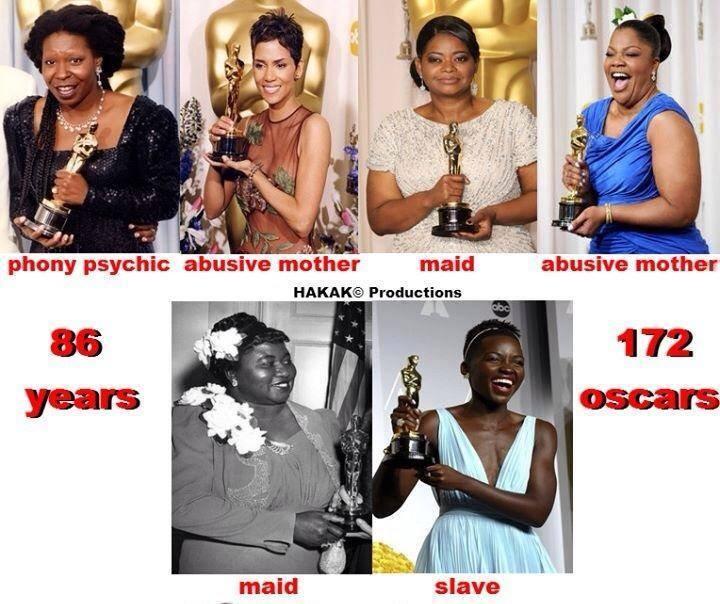
    Consider this past round of Oscars. The following meme struck me when I first saw it

    OscarsLackDiversity

    Don’t get me wrong. I will be eternally thankful to Steve McQueen and The Powers That Be for sharing The Goddess Otherwise Known As Lupita with the world. But I want something more. The silver screen rarely reflects reality, especially when it comes to people of color. We are more than sidekicks or members of the subjugated class. We own bars, we drive cars, we struggle, we thrive, we live lives.

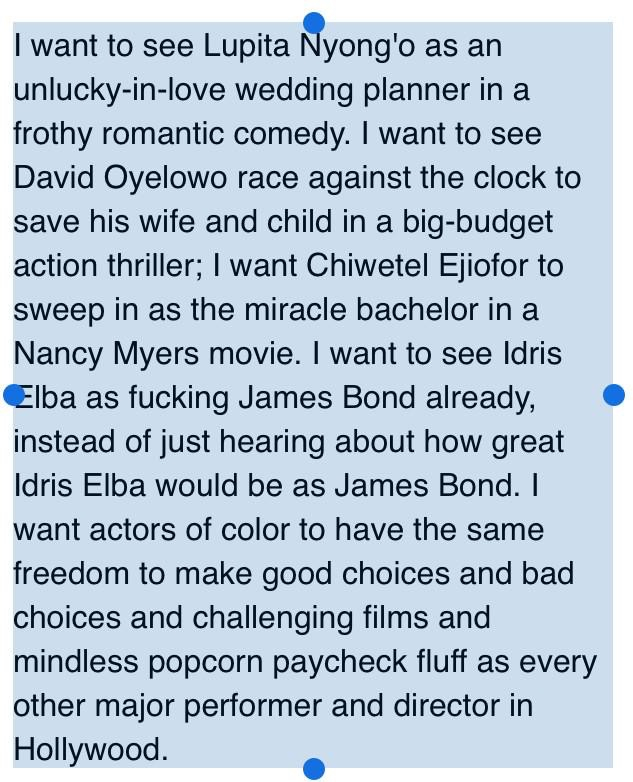
    Someone on Twitter shared the following statement. I don’t know who originally wrote it, but I could shout it from the mountaintops.

    thepowerofdiversity

    While TV shows are catching up, in terms of reflecting humanity, I think that movies are light years behind.

    And I know how things work. I realize that the films that are coming out over the next couple of years have already been cast. Hell, most have already been made. (In saying that, I’m not trying to make excuses for those who make films. I think that anyone with a basic knowledge of the industry will understand that I’m being realistic.)

    Yet going forward surely something can be done. God knows, we’re worth it.